The dating app landscape has undergone a dramatic shift. Bumble, once the undisputed runner-up in the industry behind Tinder, is now facing sustained revenue declines, user losses, and a cratering stock price. Hinge, Match Group’s fastest-growing brand, has surged past Bumble in monthly revenue for the first time since at least 2020, riding a wave of user growth, premium monetization, and a laser-focused product identity. This report provides a side-by-side comparison of all key statistics across revenue, users, demographics, engagement, and features.
Bumble vs Hinge: At-a-Glance Comparison
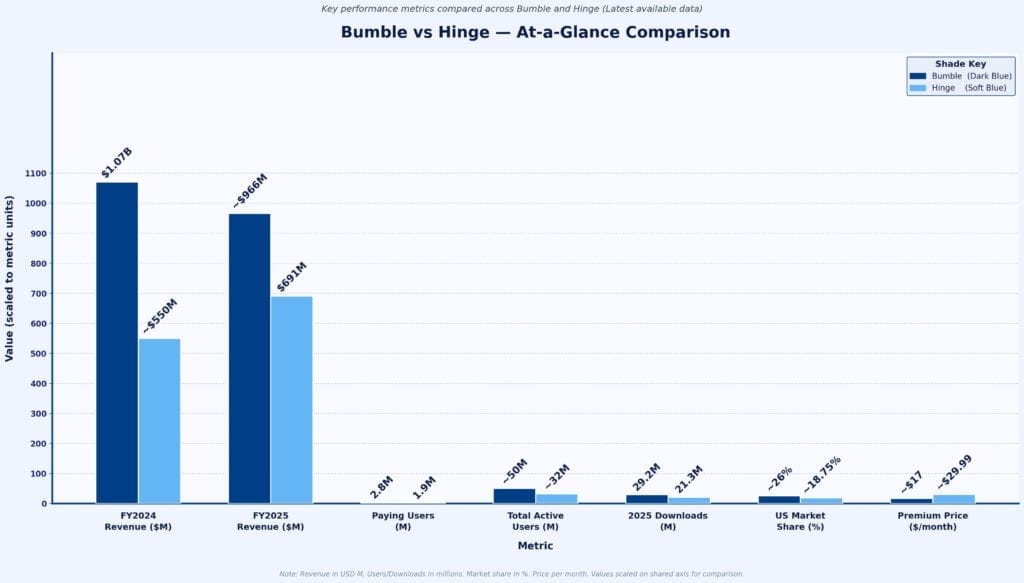
| Metric | Bumble | Hinge |
| Parent Company | Bumble Inc. (NASDAQ: BMBL) | Match Group (NASDAQ: MTCH) |
| Founded | 2014 | 2012 (relaunched 2016) |
| FY2024 Revenue | $1.07B (+2% YoY) | ~$550M (+38% YoY) |
| FY2025 Revenue (Latest) | ~$966M (declining) | $691M (+26% YoY) |
| Paying Users (Latest) | 2.8M (Q4 2024) | 1.9M (Q4 2025, +17% YoY) |
| Revenue Per Payer | ~$27.75/year (Q1 2024) | $32.96/quarter (Q4 2025) |
| Total Active Users | ~50M monthly | ~32M total |
| 2025 Downloads | 29.2M (-19% YoY) | 21.3M (+25.4% YoY) |
| Market Cap (Apr 2026) | ~$507M | Part of Match Group ($~3B) |
| US Market Share | ~26% | ~18.75% (2023) |
| Primary Goal | Women empowerment, multi-purpose | Serious relationships |
| Who Messages First | Women (in het matches) | Either party |
| Premium Price | ~$17/month | ~$29.99/month |
Bumble vs Hinge Revenue Analysis
Bumble’s Revenue Trajectory
Bumble reported total revenue of $1,071.6 million for FY2024, a modest 2% increase year-over-year. The Bumble App itself contributed $866.3 million (+3%), with Badoo and other properties making up the remainder. However, the headline figure masks a deepening crisis: revenues have been declining quarter-over-quarter throughout 2025. Q1 2025 revenue fell 8% year-over-year to $247 million, Q2 2025 fell nearly 8% to $248.2 million, and Q3 2025 dropped 10% to $246.2 million. Bumble’s paying user count also fell sharply — from 4.3 million in Q2 2024 to just 3.57 million in Q3 2025, a decline of roughly 680,000 users.
Hinge’s Revenue Surge
Hinge’s trajectory is the inverse of Bumble’s. Match Group’s fastest-growing brand posted FY2024 revenue of approximately $550 million, up 38% year-over-year. In full-year 2025, Hinge generated $691 million in direct revenue, up 26% year-over-year. In Q4 2025 alone, Hinge posted $186.5 million in direct revenue, a 26.3% increase year-over-year. This steady 25–38% annual growth is remarkable in a cooling overall dating market. Hinge’s paying users stood at 1.9 million in Q4 2025, up 17% year-over-year, and revenue per payer reached $32.96 — 8% higher than the year prior.
The Revenue Crossover Moment
For years, the hierarchy was immovable: Tinder first, Bumble second, Hinge third. That changed in mid-2025. Hinge’s monthly revenue surpassed Bumble’s across June, July, August, and September 2025 — the first time this had occurred since at least 2020. While Bumble still leads in total annual revenue for 2025, Hinge is on a clear path to overtake Bumble on an annualized basis. Appfigures estimates that in 2024, Hinge’s gross revenue rose 28% while Bumble’s dropped 3.4%.
Bumble vs Hinge: User Base and Downloads
Total Users
Bumble commands a significantly larger raw user base. The platform has approximately 50 million monthly active users globally as of 2025, though this represents a decline from 58 million in 2023. Hinge, by contrast, has around 32 million total users worldwide as of 2026, reaching approximately 30 million in 2025. Bumble also boasts over 2 billion total matches since launch and 80+ million daily swipes.
Downloads (2025)
Downloads data starkly illustrates the contrasting trajectories of the two apps:
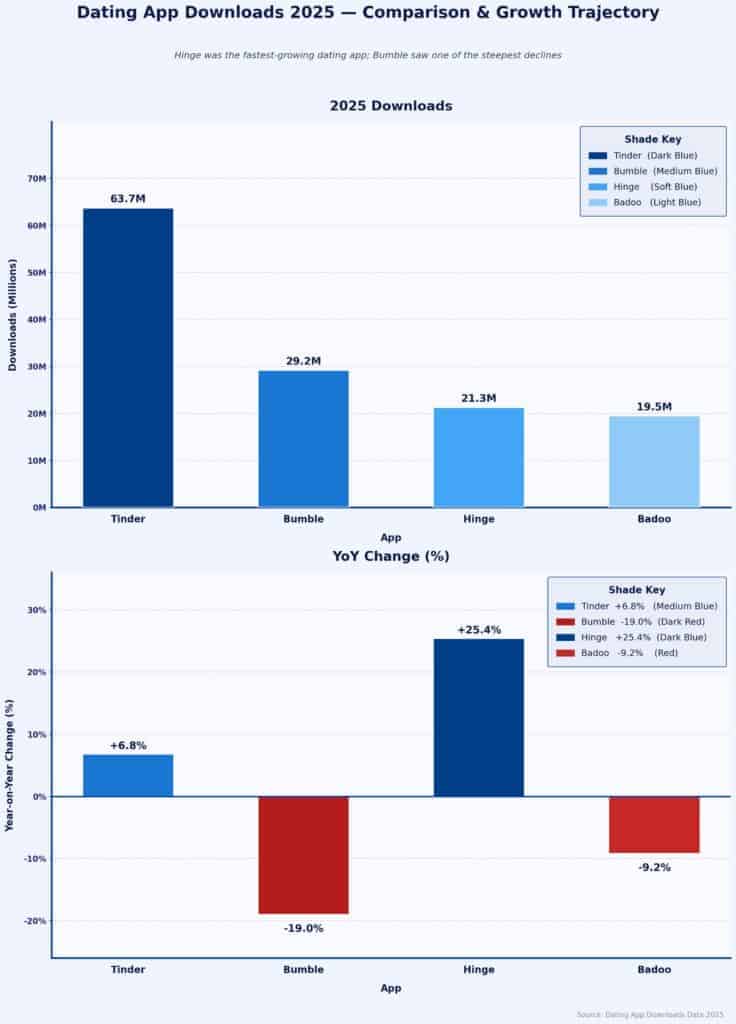
| App | 2025 Downloads | YoY Change |
| Tinder | 63.7M | +6.8% |
| Bumble | 29.2M | -19.0% |
| Hinge | 21.3M | +25.4% |
| Badoo | 19.5M | -9.2% |
Hinge was the fastest-growing dating app by downloads in 2025, while Bumble experienced one of the steepest declines among major dating platforms. This 44-percentage-point gap in growth trajectories underscores the structural competitive shift underway.
Bumble vs Hinge Demographics: Who Uses Each App?
Both apps share a broadly similar demographic profile — young adults aged 18–36 — but with important nuances in focus and depth.
Age Distribution
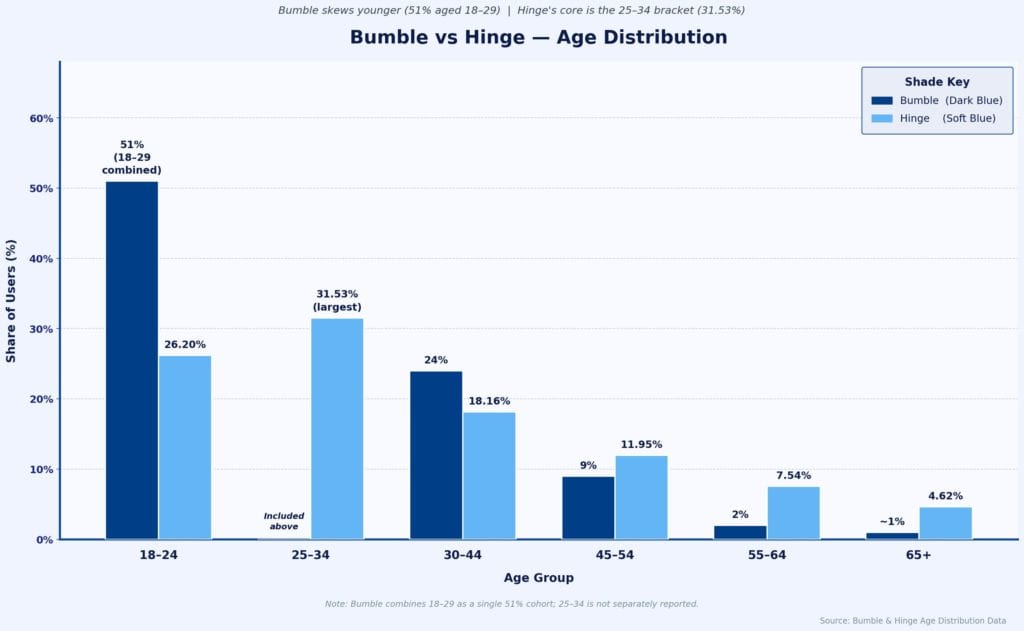
| Age Group | Bumble | Hinge |
| 18–24 | 51% (18–29 combined) | 26.20% |
| 25–34 | Included in above | 31.53% (largest cohort) |
| 30–44 | 24% | 18.16% (35–44) |
| 45–54 | 9% | 11.95% |
| 55–64 | 2% | 7.54% |
| 65+ | ~1% | 4.62% |
Bumble skews slightly younger, with 51% of users aged 18–29 and 72% under 35. Hinge’s core is the 25–34 bracket (31.53%), with 90% of users falling between ages 23–36, suggesting a slightly more established young-professional demographic.
Gender Ratio
Both platforms have a similar gender imbalance — roughly 60% male and 40% female. However, Bumble’s women-first design philosophy means the female user experience is distinctly empowered: women must initiate conversations in heterosexual matches, or the match expires in 24 hours. This mechanic makes Bumble’s gender ratio functionally more significant than Hinge’s, where any party can open a conversation.
Geography
Bumble has a truly global footprint, available in over 150 countries, with North and Latin America accounting for the largest share of downloads and revenue. The app peaked at 3.55 million monthly downloads in January 2024, with North/Latin America contributing over 1.65 million of those. Hinge has expanded aggressively and is now available in 100+ countries, with Mexico and Brazil among its 2025 expansion markets.
Bumble vs Hinge Engagement and Match Statistics
Match Rates and Conversion
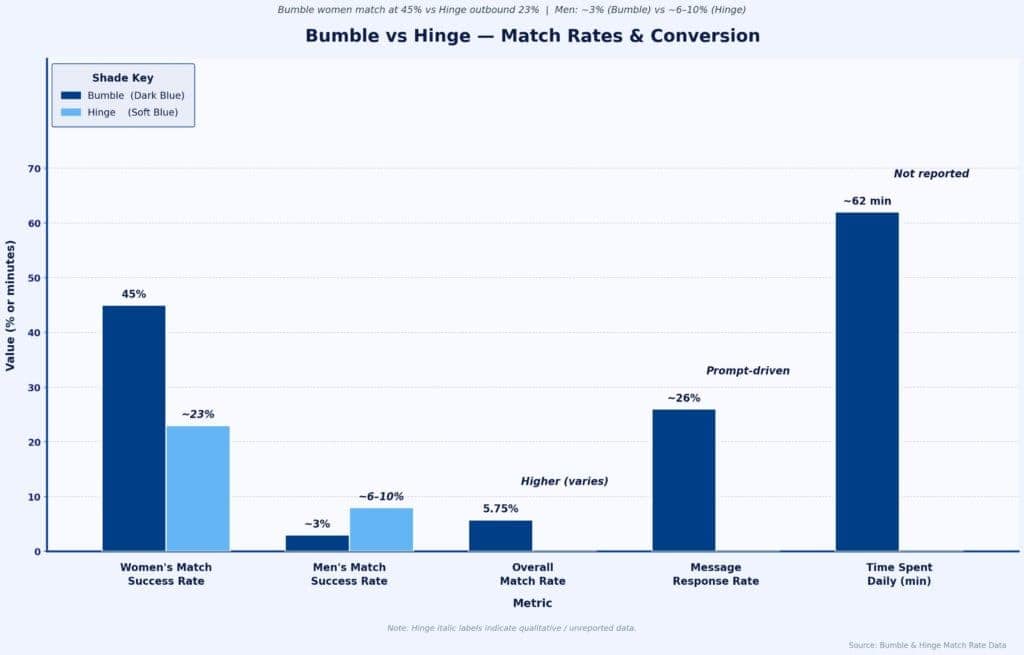
| Metric | Bumble | Hinge |
| Women’s match success rate | 45% | ~23% (outbound) |
| Men’s match success rate | ~3% | ~6–10% (varies) |
| Overall match rate | 5.75% | Higher but varies |
| Message response rate | ~26% | Prompt-driven approach |
| Time spent daily | ~62 minutes | Not widely reported |
Bumble’s women-first model creates an extreme asymmetry in match rates: women match at 45% while men match at just 3%. This is a structural feature of the design — women selectively right-swipe knowing they’ll need to initiate. Bumble’s overall match rate of 5.75% is lower than Tinder’s 16.5%, but each Bumble match is statistically more likely to lead to a conversation. About half of all Bumble matches turn into conversations.
Hinge operates differently: users interact by commenting on specific photos or prompts rather than simply swiping, which inherently raises the quality of outreach. Hinge’s algorithm was updated in 2025 to use deep learning for mutual compatibility prediction, contributing to a double-digit increase in overall matches.
Success and Relationship Outcomes
- Hinge: 90% of users who went on a date via the “We Met” feature reported it went well, and 72% wanted a second date. The app’s brand identity — “designed to be deleted” — reflects its relationship focus. In 2024, 90% of Gen Z Hinge daters said they want to find love.
- Bumble: Approximately 1 in 4 users report going on a first date through the app. The platform has facilitated over 20,000 marriages since its 2014 launch, and 20% of married couples who met through online dating apps met on Bumble (The Knot, 2024). Bumble relationships also show a slightly lower divorce rate (5.96%) compared to offline-started relationships (7.67%).
Bumble vs Hinge Features and Product Philosophy
| Feature | Bumble | Hinge |
| Core Philosophy | Women’s empowerment, safety-first | “Designed to be deleted” — real relationships |
| Initiating Chats | Women first in het matches; 24-hr expiry | Either party can respond to a prompt/photo |
| Profile Style | Swipe-based with minimal prompts | Scroll feed; prompt-based engagement similar to Instagram |
| Extra Modes | BFF (friendship) and Bizz (networking) | Romantic connections only |
| Free Tier | Yes, limited likes | Yes, limited likes |
| Premium Tier | Bumble Boost + Premium (~$17/mo) | Hinge+ (~$29.99/mo) + HingeX |
| Special Features | SuperSwipe, Spotlight, Travel Mode | Standouts, Most Compatible, Rose |
| Video Calls | In-app video calling | In-app video calling |
| Safety Features | AI-based photo verification, video verification | Selfie Verification, FaceCheck |
| AI Integration | Smart matchmaking, Icebreaker prompts | Deep learning algorithm for compatibility |
Bumble’s defining differentiator remains the women-message-first mechanic — arguably the most structurally significant UX innovation in the modern dating app market. It reduces spam and unwanted messages for women dramatically and gives the platform a unique brand identity. Hinge’s edge is in profile depth and conversation quality: rather than mindlessly swiping, users scroll a feed and engage with specific photos or prompts, creating a richer opening interaction.
Bumble vs Hinge Financial Health and Market Position
Bumble’s Challenges
Bumble’s stock has collapsed from a $8.18 billion market cap at its February 2021 IPO to just ~$507 million as of April 2026 — a 93.79% decline. The company recorded a $367 million net loss in Q2 2025, driven by a $405 million non-cash impairment charge. In June 2025, Bumble cut 30% of its workforce (approximately 240 positions). Whitney Wolfe Herd returned as CEO in early 2025, signaling a strategic reset focused on AI integration and product overhaul.
On the positive side, Bumble’s Adjusted EBITDA improved from 27.9% to 38.1% in Q2 2025, totaling $94.6 million, indicating improving operational efficiency even as revenue shrinks. The company remains profitable on an adjusted basis and maintains a healthy cash position.
Hinge’s Growth Position
Hinge is Match Group’s crown jewel and primary growth driver. Match Group’s Q4 2025 earnings beat analyst expectations with $878 million in revenue, with Hinge described as the primary top-line growth driver. Hinge’s expansion into Latin America and India is planned for 2026, and Match Group has committed to investing $50 million into AI and international expansion across Hinge and other brands. With revenue per payer at $32.96 and climbing, Hinge monetizes its users more effectively than both Bumble and Tinder.
Bumble vs Hinge Competitive Positioning: Key Takeaways
Bumble holds advantages in:
- Total user base (50M MAU vs Hinge’s 32M total)
- Total revenue still ($866M app revenue in 2024 vs Hinge’s $550M)
- Brand identity for female users — women-first model is unmatched
- Versatility (BFF, Bizz modes in addition to dating)
- Global reach (150+ countries)
Hinge holds advantages in:
- Revenue growth trajectory (26–38% YoY vs Bumble’s decline)
- Revenue per payer ($32.96 vs Bumble’s ~$21–28)
- Download growth (+25.4% vs Bumble’s -19.0%)
- Relationship outcomes focus aligned with shifting user preferences
- Backed by Match Group’s financial strength and AI investment
The central insight is that Hinge is winning on quality metrics while Bumble is losing on momentum. Hinge’s user base is smaller but growing rapidly, monetizes better per user, and is expanding into new markets. Bumble has a larger installed base and brand awareness but faces user attrition, strategic uncertainty, and a stock reflecting deep market skepticism.