Social media addiction has emerged as one of the defining behavioral health challenges of the digital age. An estimated 210 million people worldwide suffer from social media and internet addiction — roughly 4.69% of all global social media users. With 5.24 billion people now on social media (63.9% of the world’s population), the scale of compulsive and harmful usage is unprecedented. The consequences span mental health deterioration, sleep disruption, productivity losses, and strained relationships, with teenagers and young adults bearing the greatest burden.
Global Prevalence
Social media addiction is pervasive across all regions, though rates vary significantly:
- ~210 million people globally are estimated to suffer from social media addiction
- 4.69% of all social media users worldwide display addiction symptoms
- A review of data from 32 countries found addiction rates ranging from 5% to 31%, with significant variation by region and study methodology
- 36.9% of social media users globally report addiction-level behavior in some estimates
- Meta-analyses estimate 18.4% of students worldwide experience social media addiction symptoms, with Asia recording the highest student prevalence at 22.8%
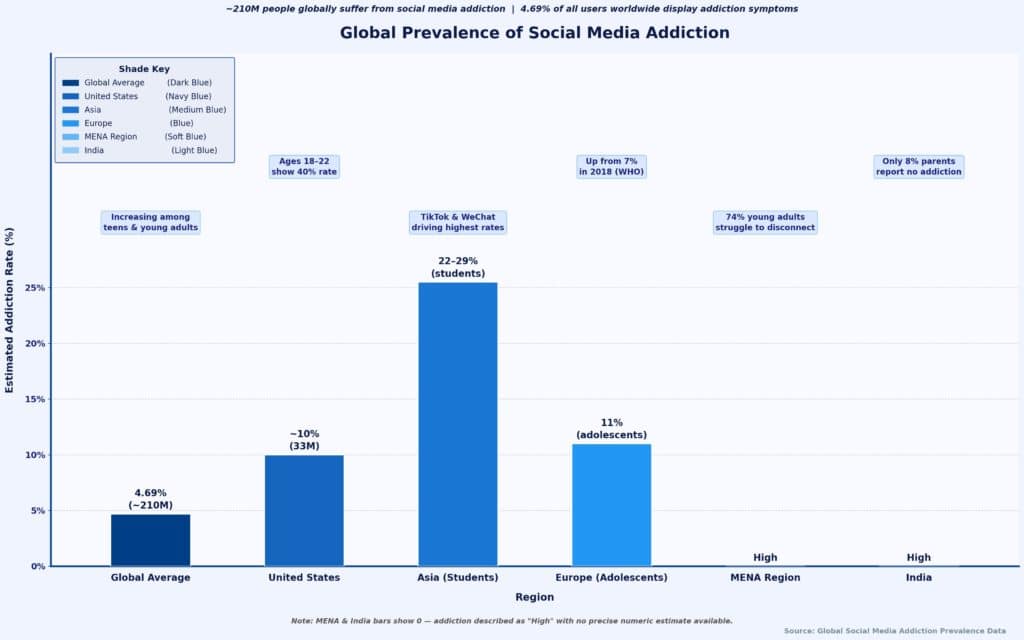
| Region | Estimated Addiction Rate | Notable Detail |
| Global Average | 4.69% (~210 million) | Increasing among teens and young adults |
| United States | ~10% (33 million) | Young adults aged 18–22 show 40% rate |
| Asia | 22–29% among students | TikTok and WeChat driving highest rates |
| MENA Region | High | 74% of young adults struggle to disconnect |
| Europe | 11% among adolescents (2022) | Up from 7% in 2018 (WHO HBSC study) |
| India | High | Only 8% of parents report no addiction in children |
Usage and Screen Time Data
Daily time spent on social media is a key driver of addictive behavior:
- The average person spends 145 minutes (nearly 2.5 hours) on social media daily
- U.S. adults spend an average of 2 hours 14 minutes per day on social media
- U.S. teens spend an average of 4.8 hours per day on seven popular social media apps, with YouTube, TikTok, and Instagram accounting for 87% of that time
- 37% of U.S. teens report spending 5 or more hours daily on social media
- Some heavily addicted teens exceed 9 hours per day on social media
- Children aged 8–12 average 4 hours 44 minutes of screen time per day
- Worldwide, a total of 12 billion hours are spent on social media daily
Use of social media for 3 or more hours per day is linked to higher rates of anxiety and depression, according to JAMA Psychiatry.
Demographics: Age Groups
Age is the strongest predictor of social media addiction risk:
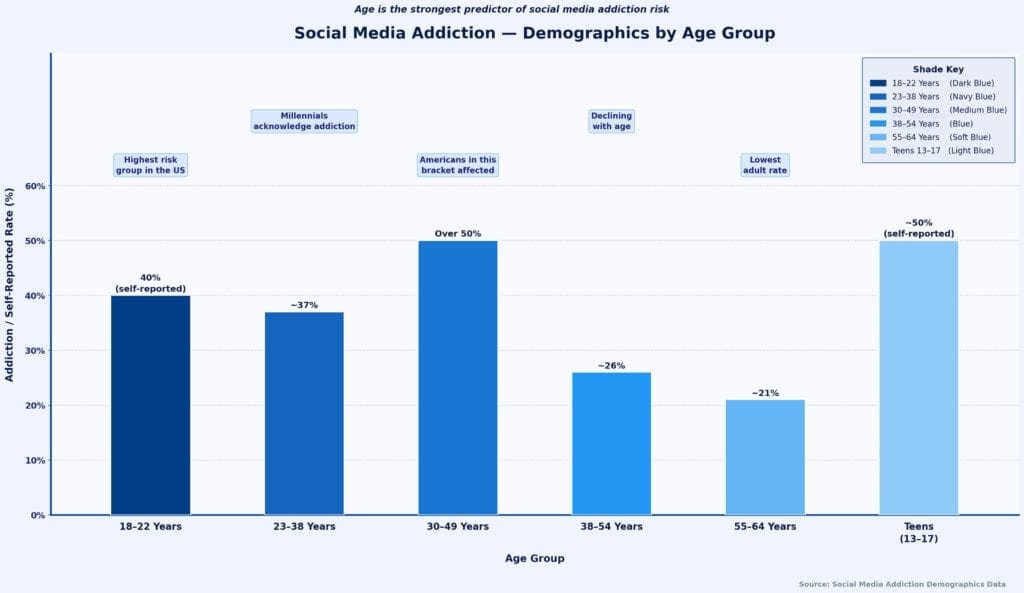
| Age Group | Addiction/Self-Reported Rate | Notes |
| 18–22 years | 40% (self-reported) | Highest risk group in the US |
| 23–38 years | ~37% | Millennials acknowledge addiction |
| 30–49 years | Over 50% | Americans in this bracket affected |
| 38–54 years | ~26% | Declining with age |
| 55–64 years | ~21% | Lowest adult rate |
| Teens (13–17) | ~50% self-report feeling “addicted” | Per multiple surveys |
- Young adults aged 18 to 22 account for 40% of all Americans addicted to social media
- Nearly 50% of teenagers in the U.S. report feeling “addicted” to social media
- Children under 5 in India spend 2.2 hours daily on screens — twice the safe limit advised by experts
- In India, among 14–16 year-olds, 76% are hooked on social media while only 57% use devices for education
Platform-Specific Addiction Data
Not all platforms carry equal addiction risk; short-form video dominates compulsive engagement:
TikTok
- TikTok ranks #1 among the most addictive social media apps in 2025 per a Media Mister study
- Users spend an average of 58.4 minutes per day on TikTok — up by 31 minutes since its launch in 2019
- TikTok generates 2,482.50 monthly searches related to screen time reduction — the highest of any app
- 41% of all 4-to-18-year-olds worldwide use TikTok; Americans alone spend over 11 days per year on TikTok
- Instagram ranks 2nd most addictive, generating 1,422.50 monthly screen-time searches
- Users average ~33 minutes per day on the platform
- 43% of teens have deleted posts due to too few likes; 43% felt bad about themselves when no one commented
- An internal Facebook team found that 12.5% of Facebook users (360 million people) suffer from compulsive use that has interfered with sleep and work
- 30% of Facebook users show signs of addiction; around 52% use the platform problematically
- Nearly 60% of Facebook users suffer from moderate depression, and more than 11% have severe depression
Mental Health Impact
The association between social media addiction and mental health disorders is among the most extensively documented findings in behavioral health research:
- Social media addiction positively correlates with anxiety (r = 0.281, p < 0.001) and depression (r = 0.327, p < 0.001)
- Depression is the most common mental health concern in studies of social media use among children and adolescents, appearing in 27.9% of studies
- Excessive social media use is associated with a 63% increase in depression
- 47% rise in anxiety and loneliness is attributed to excessive social media use
- 22% drop in happiness is linked to excessive social media use
- Among heavy social media users, 48.3% were found to have depression and 22.6% suffered from anxiety in one clinical study
- Teens aged 12–15 who use social media 3+ hours daily have twice the risk of experiencing depression and anxiety symptoms
- 41% of teens with the highest social media use rate their overall mental health as poor or very poor (vs. 23% of lowest users)
- Children and teens with social media addiction are 2–3 times more likely to experience suicidal ideation or behaviors
- Deactivating a social media platform for four weeks improved subjective well-being by 25–40% of the effect of formal psychological interventions
Mental health issues specifically associated with social media addiction include depression, self-harm, low self-esteem, eating disorders, and sleep deprivation.
Sleep Disruption
Social media addiction has a well-established link to poor sleep outcomes:
- 93% of Gen Z admit to staying up past their bedtime to view or participate in social media
- More than 60% of students report keeping their phone on (and on) in their bedroom while sleeping
- A meta-analysis of 55 studies covering 41,716+ participants found problematic social media use associated with significantly increased sleep problems (pooled effect size r = 0.33)
- Late-night digital engagement causes melatonin suppression and chronic sleep debt, impairing cognitive function and emotional stability
- Social media addiction is significantly associated with poor sleep quality — a 17.7% prevalence of addiction was found among medical students specifically linked to sleep disruption
- Sleep disruption and addictive social media use increase the risk of depression, suicidal thoughts, mood disturbances, and attention problems
Gender Differences
Research consistently identifies gender as a significant moderating variable:
- Women report higher levels of social media addiction than men across multiple studies and cultural contexts
- Women are more likely to use social media to regulate emotional states (sadness, loneliness) and report more obsessive thoughts about checking social media
- Girls show higher rates of problematic social media use than boys — 13% vs. 9% in the WHO’s 44-country HBSC study
- 55% of women exhibit signs of unhealthy social media habits vs. 60% of men in some behavioral measures (though men’s issues differ in nature)
- Men are more likely to experience negative outcomes from use (e.g., neglecting offline activities), while women are more likely to use social media as a coping mechanism
- 60% of men exhibit signs of unhealthy social media habits overall, compared to 55% of women
Neurobiological Mechanisms
Social media addiction shares neurobiological pathways with substance dependency:
- Social media platforms exploit dopamine reward feedback systems, causing desensitization and compulsive checking behaviors
- Extended social media exposure alters dopamine regulation, reinforcing addictive tendencies similar to substance dependence
- “Using social media lights up the same parts of your brain as other addictions, such as drugs, alcohol, and gambling” — London Southbank University researcher Laura Elin Pigott
- Frequent use triggers neural pruning — the brain adapts to habitual dopamine release, making reward pathways faster but also increasing impulsivity and reducing emotional control
- Platforms leverage machine learning algorithms and variable-ratio reinforcement schedules (same mechanism as gambling) to maximize dopamine spikes and extend session duration
- Neuroimaging studies show increased glucose metabolism in brain regions associated with impulsivity and reward dependence among excessive social media users
- Adolescents with genetic variations in dopamine D2 receptor encoding show heightened vulnerability to social media addiction
Productivity and Economic Impact
Social media addiction imposes measurable economic costs at both individual and national levels:
- In Argentina, productivity losses from social media and smartphone distractions in 2023 accounted for 12.73% of gross value added — with highly exposed sectors losing up to 17%
- Average daily social media use of 2.35 hours (approximately 32% of a workday) results in a 13% overall productivity loss
- Workers check smartphones roughly every 18 minutes, causing persistent focus disruption
- India’s Economic Survey 2025–26 flagged digital addiction as a “quiet but serious risk” — Indians spent 1.1 lakh crore hours on smartphones in 2024, the highest globally
- There has been a 101.7% surge in “frequent mental distress” among young adults (18–25) in India over the last decade, closely correlated with digital addiction
- The Economic Survey 2025–26 warns of addiction’s impact on academic performance, workplace productivity, and India’s long-term economic competitiveness
Youth-Specific Findings
Young people constitute the most vulnerable and heavily studied population:
- The WHO’s 2024 European HBSC study (280,000 adolescents across 44 countries) found that 1 in 10 adolescents (11%) show signs of problematic social media behavior — up from 7% in 2018
- 36% of young people report constant online contact with friends, with the highest rates (44%) among 15-year-old girls
- 10% of the highest-use teen group expressed suicidal intent or self-harm in the past 12 months — vs. 5% of the lowest-use group
- 17% of heavy teen users expressed poor body image vs. 6% of low users
- Adolescent major depressive episodes increased from 8.7% in 2005 to 11.3% in 2014, with social media usage proposed as a contributing factor
- Strong parental monitoring can cut teen mental health risks substantially — 22% of high users with poor parental relationships expressed suicidal thoughts vs. 2% of high users with strong parental relationships
- 70% of teens reported feeling left out or excluded when using social media
Key Takeaways
Social media addiction is not a fringe issue — it is a mainstream behavioral health challenge with measurable neurobiological, psychological, and economic consequences.
- Scale: 210 million addicted users globally; 5% to 31% prevalence depending on region and methodology
- Most at risk: Women, teens aged 13–22, heavy TikTok/Instagram users, and those with weak parental oversight
- Core mechanism: Dopamine-driven reward pathways exploited by algorithmic design, mirroring substance addiction in the brain
- Top consequences: Depression, anxiety, sleep disruption, productivity loss, and in severe cases, suicidal ideation
- Promising intervention: A 4-week social media detox can improve well-being by 25–40% of the effect of formal therapy
- Trend direction: Problematic use rates among adolescents rose sharply between 2018 and 2022, with no signs of reversal.